
Book a Call
Request a Proposal
The 5R Framework™
A 4 week diagnostic* that scores your supply chain operation across five resilience dimensions — and identifies the AED 5–50M of capability gaps blocking next year's performance.
*Tier II 5R Diagnostic typically takes 4 – 5 weeks; depending on the chosen format, it may range from 2 – 6 weeks. See details below.
The 5R Framework™
A 4 week diagnostic* that scores your supply chain operation across five resilience dimensions — and identifies the AED 5–50M of capability gaps blocking next year's performance.
18 YEARS · DANONE · CARLSBERG · PEPSICO · LEROY MERLIN · PwC MIDDLE EAST · LED 100+ STORES GCC RETAIL OPERATION
Why this framework exists
After 18 years of operating supply chains across FMCG, Big-4 consulting, and GCC retail, one pattern became clear: most diagnostic frameworks were either too academic to act on, or too generic to reflect the realities of supply chains operating in the Gulf.
The 5R Resilience Framework™ solves that. It is grounded in measurable operational evidence, sequenced causally (each dimension enables the next).
After 18 years of operating supply chains across FMCG, Big-4 consulting, and GCC retail, one pattern became clear: most diagnostic frameworks were either too academic to act on, or too generic to reflect the realities of supply chains operating in the Gulf.
The 5R Resilience Framework™ solves that. It is grounded in measurable operational evidence, sequenced causally (each dimension enables the next).
What you walk away with
Three deliverables, four weeks*, one decision-ready output.
-
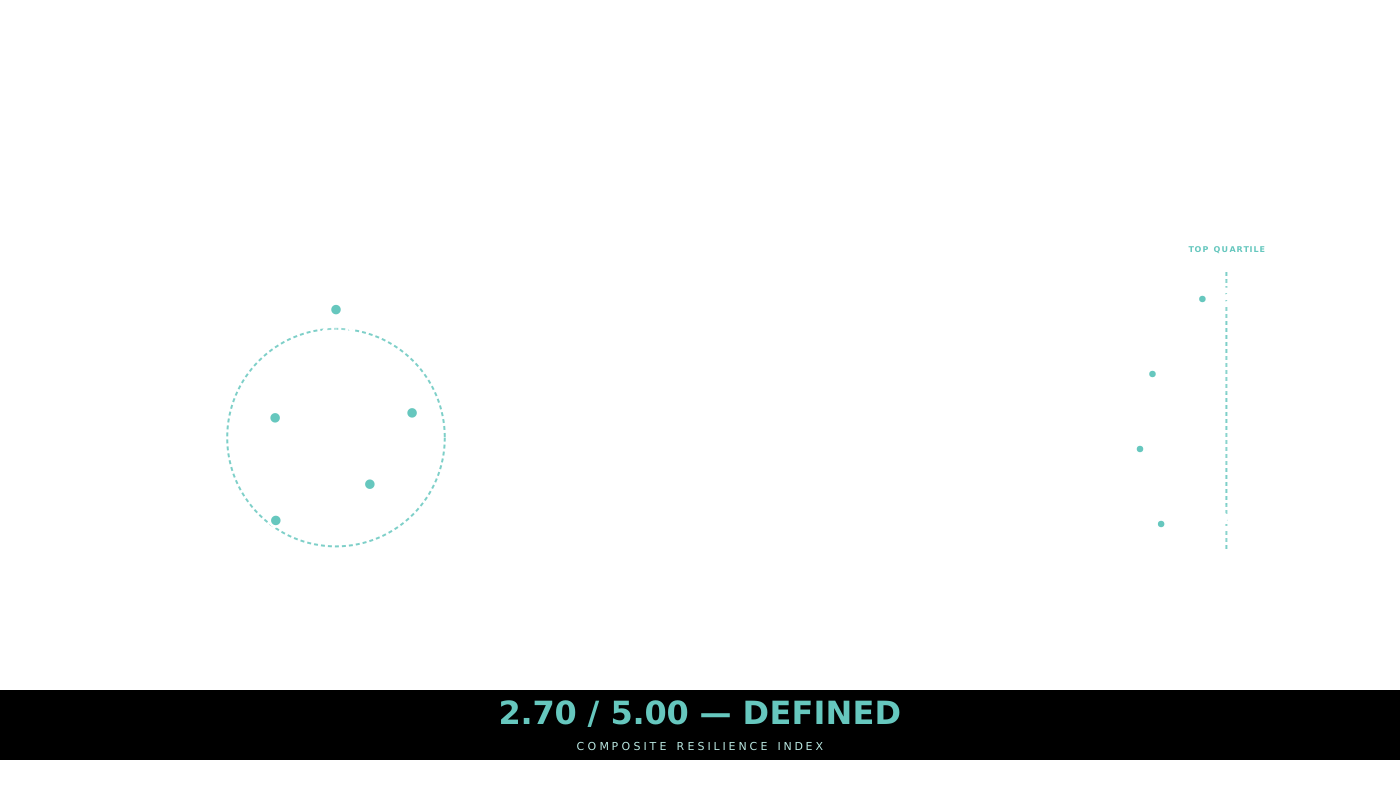
 0-5 scale, composite + dimension breakdownResilience Index8-12 prioritized initiatives with quantified value range (Tier 1 / Tier 2 / Tier 3 in AED) and capture roadmap traced to specific operational levers.
 -
 Quantified initiatives, prioritizedOpportunity Register8-12 prioritized initiatives with quantified value range (Tier 1 / Tier 2 / Tier 3 in AED) and capture roadmap traced to specific operational levers.
 -
 Sequenced, owned, milestone-driven90-Day PlanSequenced execution plan — what starts in 30 days, 60 days, 90 days — with owner accountability and capture milestones for each initiative.
Total scope: 200 evidence questions across 14 stakeholder interviews, scored against industry-standard maturity rubric.
The methodology behind it
Each output traces back to five operational dimensions
The Resilience Index isn't a single number — it's a composite score across five interconnected dimensions of operational capability. The Opportunity Register isn't a brainstorm — every initiative ties to a specific dimension where evidence revealed a gap. The 90-Day Plan isn't sequenced arbitrarily — it follows the causal order of the framework, because investing out of sequence consistently under delivers.
Each output traces back to five operational dimensions
The Resilience Index isn't a single number — it's a composite score across five interconnected dimensions of operational capability. The Opportunity Register isn't a brainstorm — every initiative ties to a specific dimension where evidence revealed a gap. The 90-Day Plan isn't sequenced arbitrarily — it follows the causal order of the framework, because investing out of sequence consistently under delivers.
What the 5R Diagnostic produces
How maturity is measured
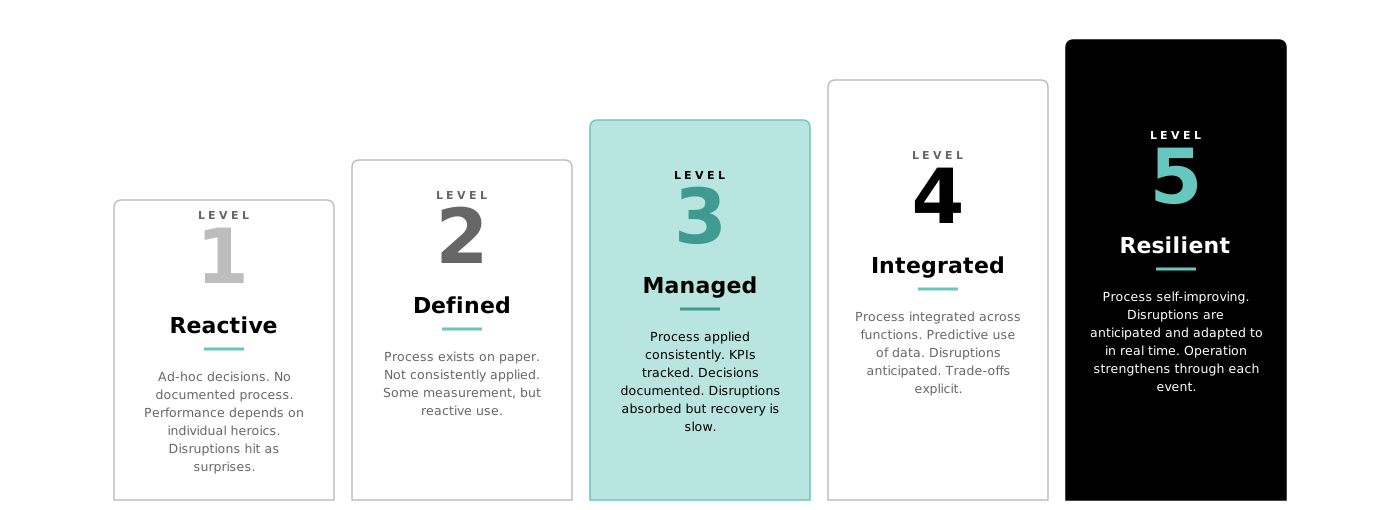
Every R-dimension is scored on a five-level maturity scale.
Scores are not subjective — they trace to documented evidence captured during structured interviews across 14 stakeholder roles. Two operations with the same composite score can behave very differently under disruption; the framework exposes that.
Scores are not subjective — they trace to documented evidence captured during structured interviews across 14 stakeholder roles. Two operations with the same composite score can behave very differently under disruption; the framework exposes that.
Beyond the 5R: The Resilience Behavior Lens
The 5R Framework measures where capability lives.
The Resilience Behavior Lens maps each R-dimension's contribution to four temporal phases of resilience.
The Resilience Behavior Lens maps each R-dimension's contribution to four temporal phases of resilience.
- Phase 1:
AnticipateBefore disruption.- Detecting emerging risks early enough to act before they materialize.
- Forecast signals that surface category shifts before they hit the shelf.
- Supplier monitoring that flags distress before delivery fails.
Primary contributors: R1 · R4 - Phase 2:
AbsorbDuring disruption.- Continuing to function under stress without systemic failure.
- Inventory buffers holding while alternative supply is arranged.
- Network design serving demand from secondary nodes when primary nodes are down.
- Phase 3:
AdaptDuring disruption.- Reconfiguring operations in real time as conditions shift.
- Sourcing alternatives activated within days, not months.
- Distribution routing rerouted while transit times deteriorate.
Primary contributors: R3 · R4 - Phase 4:
RecoverAfter response.- Restoring performance quickly and reconciling what changed.
- Inventory positions normalized.
- Supplier base rebuilt.
- Lessons captured before the organization forgets.
Primary contributors: R1 · R5
The diagnostic engine computes both views automatically — 5R maturity scores and
four-phase performance scores — from the same 200-question evidence assessment.
four-phase performance scores — from the same 200-question evidence assessment.
3 Engagement Tiers:
TIER I
5R Pulse
55,000 AED
- 2 weeks
- All 5R・75 questions
- Pulse snapshot (1-pager)
TIER II
5R Resilience Diagnostic
125,000 AED
- 4-5 weeks
- All 5R・200 questions
- Opportunity Register + 90-day plan
TIER III
Strategic Diagnostic
195,000 AED
- 5-6 weeks
- Full + executive workshop
- 60-day support implementation support